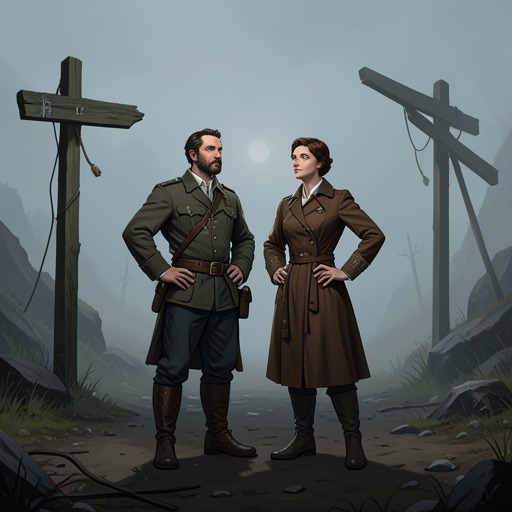
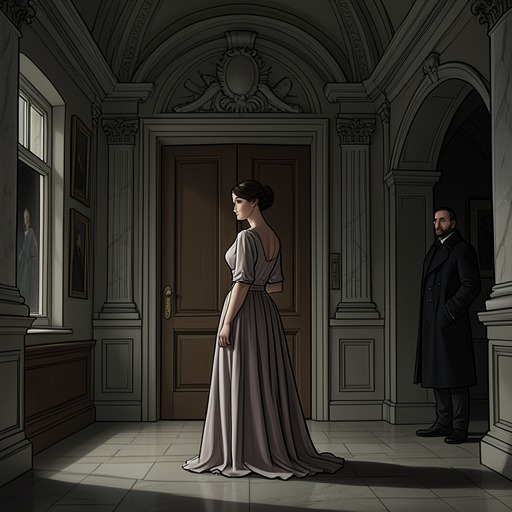
Anthony Cade—Virginia Revel
The Secret of ChimneysAnthony Cade and Virginia Revel move from wary allies in a murder investigation to lovers and spouses, with their private bond ultimately entangled in the public question of who may rule Herzoslovakia. Their relationship is built through shared danger and selective trust: Anthony’s concern for Virginia shapes what he tells the police, while Virginia’s willingness to follow him into uncertainty becomes part of the story’s final royal revelation.
From Acquaintance to Uneasy Alliance
Anthony’s interest in Virginia is present from the beginning of their connection, but it is not initially matched by an explicit declaration from her. As the investigation develops, he treats her knowledge of Herzoslovakia as crucial. He reasons that she is the only person at Chimneys who knew Prince Michael by sight, and therefore might recognize whether the murdered man was an impostor. He asks her to help secure access to the body so that this possibility can be tested. Their alliance is practical as well as personal: Virginia’s knowledge may clarify the crime, while Anthony depends on her judgment in a case where identities cannot safely be taken at face value.
That uncertainty is mirrored in Anthony’s own conduct. Within twenty-four hours he has become involved in two crimes; he has deliberately disposed of a body, obstructing justice, and then arrived at the scene of another crime as it was being committed. He recognizes the peril his actions have created and decides to tell the truth with one small alteration and one serious omission. The relationship therefore takes shape in a world where candor is compromised from the outset. Anthony’s secrecy is not a simple absence of trust: at a later point he explains that he withheld information for Virginia’s sake, and that he can speak more fully once evidence has cleared her of involvement.
Love, Risk, and the Red Signal
In a quiet walk near the house, passing the rose garden, Anthony finally names the imbalance he thinks he sees between them. He believes Virginia does not care for him, or for anyone else, yet admits that he wants to make her care. His confession combines desire with foreboding: he recalls that from their first meeting in Pont Street he knew she was someone who could hurt him. He imagines that she will marry a respectable, prosperous man while he returns to his disreputable life, and vows that he will kiss her before leaving.
The recurring image of the red signal gives his attraction the character of a warning as well as an invitation. Anthony frames love as something he has recognized as dangerous, not as a safe escape from the disorder around them. Virginia answers his declaration with a question about whether he could win her affection, leaving the possibility open without promising it. Then she points out the immediate obstacle: Superintendent Battle is watching from the library window. Their intimacy is continually observed and constrained by the investigation, and the moment’s wit does not dissolve that danger. Instead, the watcher at the window makes the contrast sharper between their private exchange and the public scrutiny surrounding them.
Anthony’s earlier decision to protect Virginia also gives this confession a practical consequence. When Battle asks why he has finally disclosed what he knows, Anthony says he has come to respect the superintendent’s abilities and does not want to cramp the investigation by withholding facts. He adds that until then he could not speak for Virginia’s sake. Now that the letters have been proved irrelevant to her, suspicion of her complicity has become untenable. His account does not present love as detached from judgment: he has weighed what disclosure could do to her, and only changes course when the evidence alters the risk. The relationship thus develops through both emotional exposure and decisions about what may safely be revealed.
Trust in the Night
Later, when Anthony is in a tight place, he sends Virginia a note asking her to trust him and come to him. The message is carried by a slip of paper weighted with a stone and dropped accurately at her feet. Its plain request is strikingly different from the careful calculations that have governed their dealings: this time Anthony asks directly for her confidence, without explaining the danger in the note itself.
Virginia responds through action. She changes into a fawn tricot dress and matching leather hat, writes a short note to Bundle, and pins it to the pincushion. Then she quietly goes downstairs and undoes the bolts of the side door. She pauses for a moment before passing through with a gallant toss of the head associated with her ancestors going into action in the Crusade. Her choice is not made in ignorance of the peril around her: detectives are stationed outside the council chamber, and Anthony has arranged a car on the road. She nevertheless leaves under her own power, turning his request into a test of trust that she answers decisively.
Marriage and the Royal Revelation
Anthony’s declaration of marriage first appears within a conversation about his possible kingship. When the Baron celebrates the prospect of seeing him King of Herzoslovakia, Anthony casually interrupts the royal fantasy to say that there is a string attached: he is married. The news dismays the Baron, who imagines that Anthony has married a woman whose background would complicate the plan. Anthony rejects the idea of a merely morganatic arrangement. Virginia, he insists, will be Queen beside him; she is the daughter of an English peer whose family reaches back to the Conqueror, and she knows something of Herzoslovakia.
George Lomax is startled to hear that the bride is Virginia Revel, and Anthony confirms it. When Herman Isaacstein asks when the marriage took place, Anthony answers that it happened that morning. The timing makes the disclosure more than a future political arrangement: before the revelation of Anthony’s real identity, the marriage has already been made. Virginia is not being introduced as a prospective consort selected after his accession; the personal commitment precedes the public explanation of what their marriage may mean.
Anthony then confesses to Virginia that he is not a changeling or the hero of a romantic transformation, but Prince Nicholas Obolovitch of Herzoslovakia. Her astonishment is sharpened by the practical fact that she has already married him. Anthony proposes that they go to Herzoslovakia and pretend to be king and queen, recalling Jimmy McGrath’s estimate that the average life of a king or queen there is under four years. Virginia’s response is enthusiastic rather than apprehensive: she says she will love it. The political danger is not erased; the short expected reign gives it a pointed measure. But the proposal turns their marriage into a shared undertaking, and Virginia accepts both the identity revealed and the uncertain future attached to it.
Partnership and Ending
The last intimate exchange returns to the earlier moment when Battle watched them from the library. Virginia remembers that interruption; Anthony answers that the superintendent is no longer watching. He draws her to him and kisses her, then asks whether she loves him. The answer, delivered quietly with her head against his shoulder, is a teasing denial: she says she does not care for him at all. Anthony takes the joke as confirmation of the affection between them and replies that he now knows he will love her until he dies.
The shift from Virginia’s question about whether Anthony could make her care to her playful denial marks the relation’s change without making it solemn or frictionless. The book ends their romance not with a political guarantee but with an agreement to face an unstable future together. Their alliance has widened from investigating a potentially false identity to confronting Anthony’s actual royal identity; Virginia’s trust and willingness to become Queen make her a partner in that future, not merely its ornament. The red signal that once made love seem like impending hurt remains part of the relationship’s history, but the ending converts its warning into a risk the two have chosen to share.